How AI Changes Scenario Modeling for Health System Finance

How AI Changes Scenario Modeling for Health System Finance

Every year, a health system finance team spends months building next year’s budget, usually with a base case, a best case, and a worst case. The worst case often ends up being the base case with some volume taken out.
The actual year then brings a respiratory surge during a nursing shortage, a chemotherapy drug shortage, and a payer changing prior authorization rules mid-contract, none of which appeared in the model. None of that was in the budget. When each scenario takes a week to build, there’s only time for a few, and the unusual ones rarely make the cut. With AI, a scenario takes minutes instead of days. Building them is no longer the bottleneck. Deciding which assumptions to believe is.
Scenarios used to be expensive
AI changes the cost and agility of that work more than it changes anything else. Drafting a disruption, translating it into model inputs, and running it now takes minutes where it used to take days. Once a scenario is nearly free, the hard part shifts from building scenarios to deciding which inputs to trust, reviewing them, and agreeing what the organization will do when one of them starts to come true.
For a finance team, that means leaders see a range of outcomes and the drivers behind it, analysts spend their time reviewing and approving what the system drafts, and a VP of finance can ask what happens to Q3 margin if infusion volume drops 15% and have the answer the same afternoon.
The model never does the math
If you read our post on how our agent answers a question about colonoscopy performance, this will sound familiar: in that system the agent names what it wants, and the server builds and validates the query against a contract the agent can't deviate from.
Scenario modeling follows the same rule: the language model proposes the inputs, and a validated model computes the results.
The LLM drafts disruptions and a first pass at their parameters, finance reviews and approves each parameter set with a record of who decided and why, and the statistical, actuarial, and financial models the team already trusts do every calculation.
This matters because a language model can write a convincing paragraph about a 12% drop in outpatient volume and still get the margin arithmetic wrong. Keeping it out of the arithmetic means every figure traces back to a known model and an approved input, which is what a CFO needs before signing off.
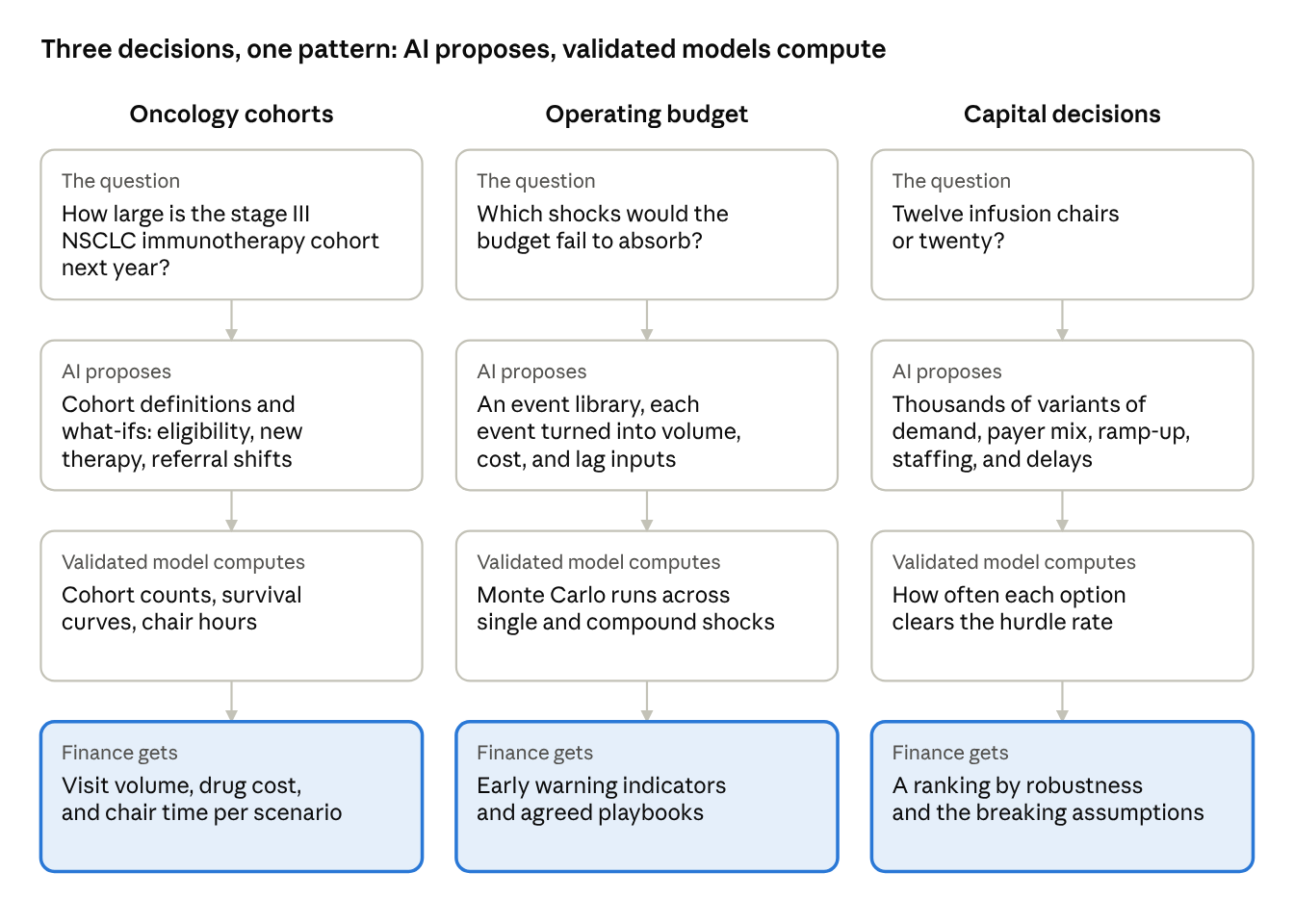
Three areas where health system finance teams spend much of their year show how this works in practice: oncology cohort planning, the operating budget, and capital decisions.
Oncology cohorts, without the queue
Much of an oncology budget depends on the size of its patient populations. A service line director can describe a cohort, such as stage III non-small cell lung cancer patients starting immunotherapy within 60 days of diagnosis, and test changes in eligibility, new therapies, or referral patterns in minutes, with each result expressed as visit volume, drug cost, and chair time.
This work rarely requires the model to see patient records. Queries run against the data and write to a file, a script returns only counts and rates, and model logic is developed on synthetic patients. When identifiable records are genuinely needed, the AI runs on infrastructure covered by the appropriate agreements, with no calls to external tools while that data is in context.
Budgeting for the shock you didn't plan for
Most budgets treat disruption as something to explain after the fact. With cheap scenarios, the system can draft a library of plausible disruptions, such as a respiratory surge, a nursing strike, a ransomware outage, or site-neutral payment reform, and translate each one into parameters a model can use, which finance then reviews and records in an assumption registry.
Monte Carlo runs then combine those events, because the shocks that hurt most tend to arrive together. The result is a short list of early warning indicators with responses agreed in advance, so the organization learns which shocks it can't absorb while there is still time to plan for them.
Twelve chairs or twenty?
A new infusion center or PET-CT is a decade-long bet that usually reaches the capital committee with one pro forma and a few sensitivity tables. In a hypothetical choice between a 12-chair and a 20-chair infusion center, the larger option wins on the base case, but across a few thousand variants of demand, payer mix, ramp-up speed, and nurse hiring, it clears the hurdle rate less often.
Ranking options by how often they clear the hurdle gives the committee a better read on a long-lived bet. The same runs show which assumptions most often flip a project from good to bad, in this case ramp-up speed and nurse hiring, so diligence can focus there.
What's underneath
All three examples run on the same stack, and most of the work and the trust sits in the parts that aren't AI: a governed semantic layer, validated models, and a review step that records who approved what.
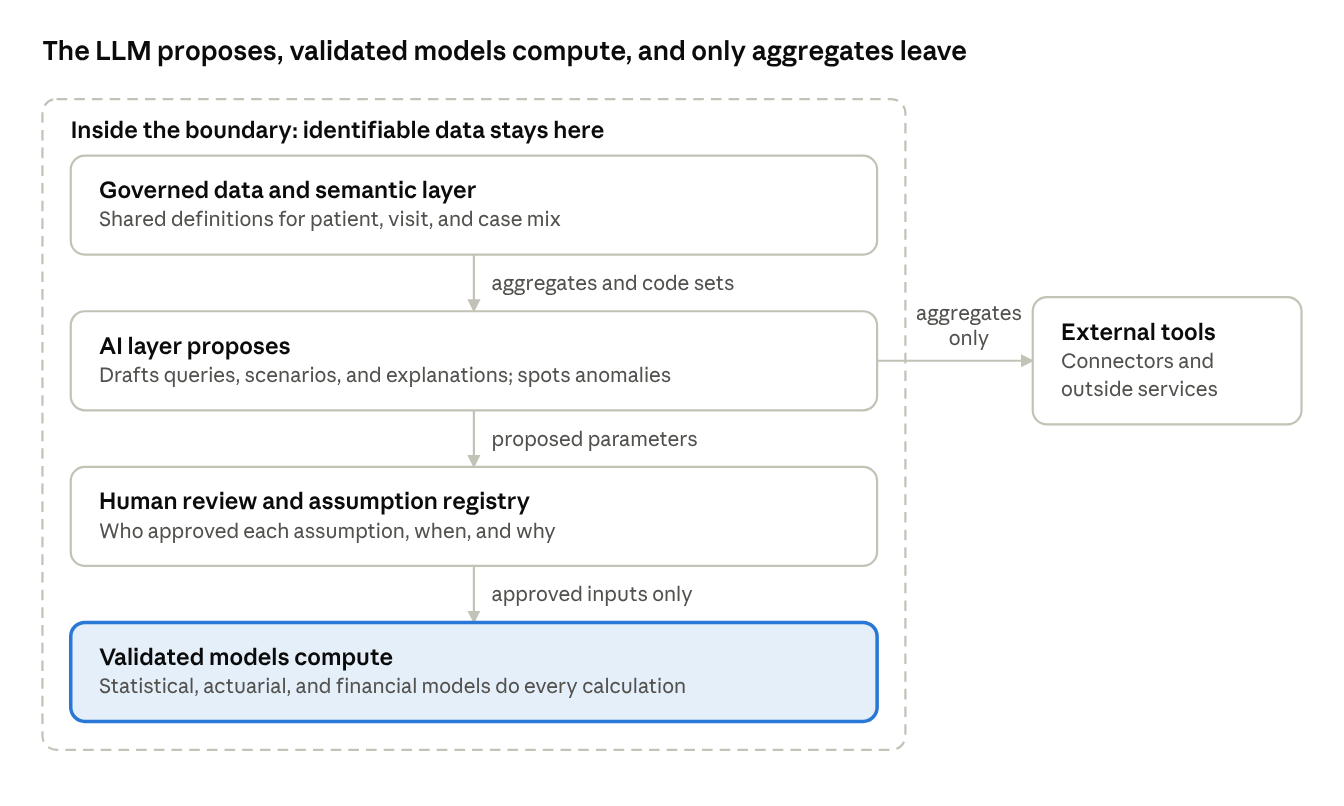
Every scenario moves down the stack, and no input reaches the models until a person approves it. Only aggregates cross the dashed line to outside tools and connectors.
What can go wrong
The most common failure is false precision. A Monte Carlo run over 10,000 scenarios inherits every error in its input distributions, and a smooth output histogram can make a poorly calibrated parameter, such as a guessed surge duration or an unsupported volume elasticity, look as credible as one fitted to historical data. Every parameter that enters the model therefore needs a source, an owner, and an approval date in the assumption registry. Output design matters as well: leadership decisions depend on the tail, so results should surface the handful of scenarios that breach margin or liquidity thresholds, along with the drivers behind them, which a full distribution of outcomes tends to obscure.
Bias is the second risk. Parameters calibrated on historical claims and encounter data carry forward past referral patterns, payer mix, and coding practices, so they should be checked against recent periods and adjusted where those patterns have shifted. Scenario work also rarely requires patient-level data, since cohort sizes, utilization rates, and cost distributions can all be computed upstream, and building the pipeline around those aggregates from the start keeps protected health information out of the AI layer entirely.
Where to start
A million spreadsheets and custom models are not just creating more work for the team, it fundamentally invites confusion. With AI-native scenario modeling, the source of truth remains consistent across the organization. This foundation allows near infinite analysis to branch out and then be rolled back into consensus with new agreements on the fundamental driving assumptions. The result, a health system that continues to move forward from a shared understanding of the past and expectations for the future.